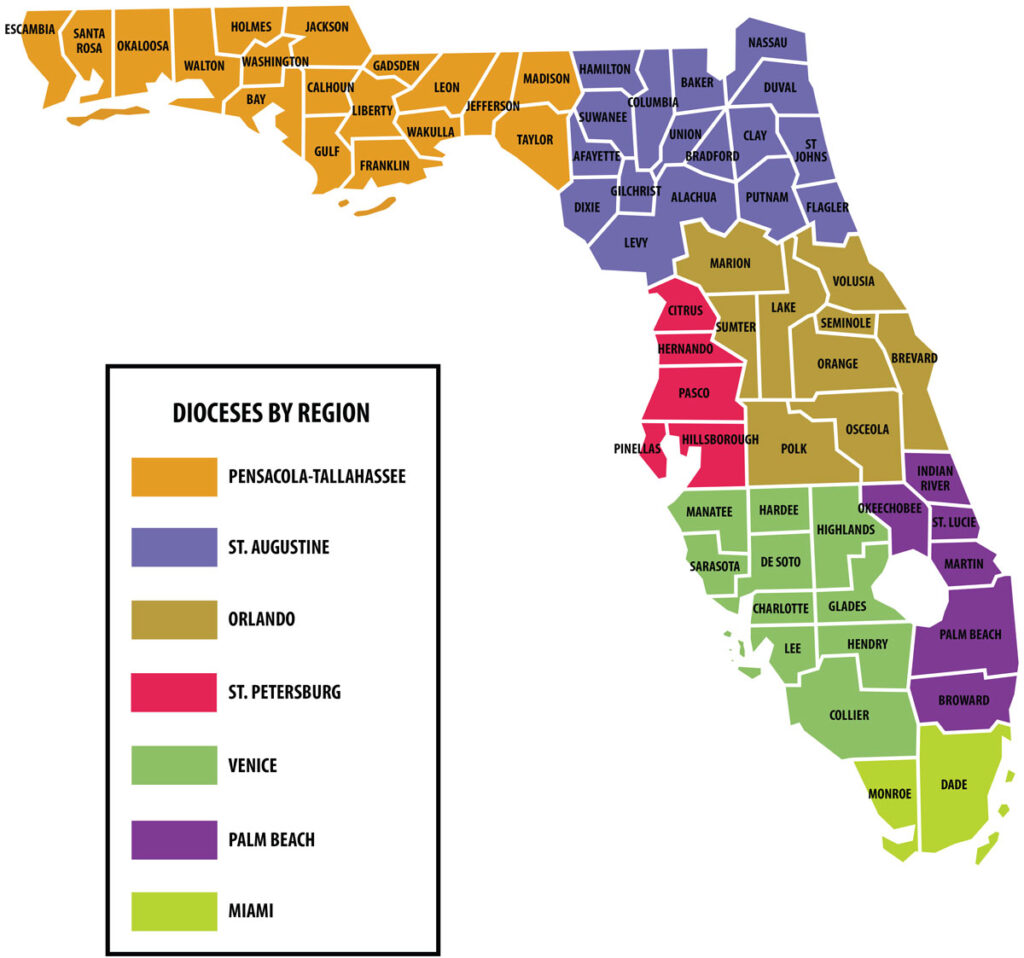
The Diocese of St. Augustine
Established March 11, 1870
The story of the Catholic Church in the United States begins in St. Augustine, Florida. On Sept. 8, 1565, Spanish explorers led by Admiral Pedro Menéndez de Avilés came ashore and celebrated the first parish Mass on these North Florida shores. They named their new settlement St. Augustine in honor of the saint whose feast day they had sighted land. With that first celebration of the Eucharist, the seeds of Christianity were sown in America north of Mexico.
St. Augustine became the cradle of the Catholic faith in this land. It is home to the first parish church, now the Cathedral Basilica of St. Augustine. From here, Franciscan missionaries traveled north and west along routes that became known as the mission trails, bringing the Gospel to Indigenous peoples and new settlements. The first schools, hospitals and charitable works in Florida also trace their beginnings to this mission-centered community.
On March 11, 1870, Pope Pius IX formally established the Diocese of St. Augustine, encompassing all of Florida east of the Apalachicola River. From this mother diocese, the Catholic Church in Florida grew steadily—eventually giving rise to six additional dioceses and a thriving Catholic population of nearly two million.
Today, the Diocese of St. Augustine includes 17 counties across Northeast Florida, from the Gulf of Mexico to the Atlantic Ocean, covering more than 11,000 square miles and serving more than 165,000 registered Catholics. It remains a living witness to the same missionary spirit that first brought the Catholic faith to these shores more than 450 years ago.
To learn more about the diocese, its leadership, parishes, schools and its outreach ministries, visit https://dosafl.com.